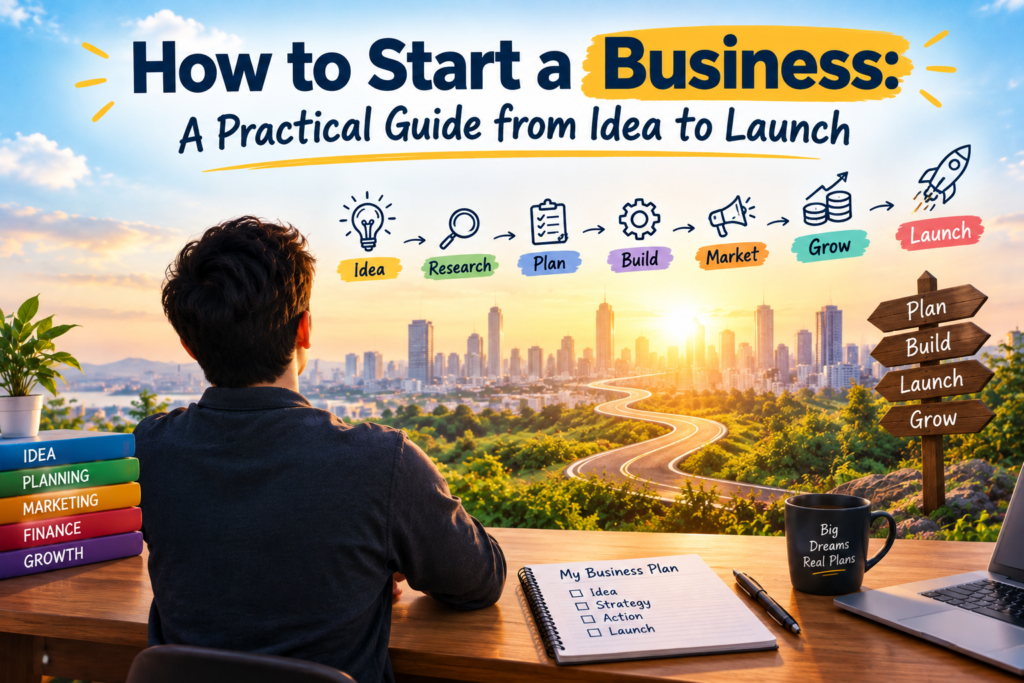
How to Start a Business: A Practical Guide from Idea to Launch
Starting a business often sounds easier than it actually is. You may see a successful shop, online store, or growing company and think, “I could do that too.” But once you decide to take the first step, practical questions quickly appear.
What should you sell? Who will buy it? How much money do you need? How will you find your first customers? What if the business does not perform as expected?
The truth is that starting a business is not simply about investing money. A sustainable business usually begins with a clear idea, a real customer need, careful planning, and consistent execution.
You do not necessarily need a large investment or a completely original concept. In many cases, a business starts by solving an existing problem in a better, simpler, or more convenient way.
Choose the Right Business Idea
The first step in starting a business is choosing an idea that has practical potential.
One common mistake is copying a business simply because it worked for someone else. A successful business in one market does not automatically become a successful business in another. Your customers, competition, location, budget, skills, and market conditions may be different.
Instead of asking, “What business is making money right now?” ask:
- What problems do people regularly face?
- What products or services are difficult to find?
- What are customers willing to pay for?
- What existing services could be made faster, easier, or more convenient?
- Can technology help solve the problem?
A strong business idea usually begins with a genuine customer need.
Assess Your Skills and Resources
A good business idea should also fit your skills, experience, and available resources.
For example, someone with graphic design skills may be able to start a design service with relatively little investment. Someone with teaching experience might start an online education business, while a person with product sourcing experience may explore e-commerce.
You do not need to know everything before starting. As the business grows, you can hire freelancers, employees, or specialists. However, using the skills you already have can help keep your initial costs under control.
It is also worth considering how much time you can realistically dedicate to the business. A business that requires daily involvement may not be suitable for someone who can only work on weekends.
Understand Your Market
Before investing heavily, find out whether there is a real market for your product or service.
Many new entrepreneurs make the mistake of assuming that a good product will automatically attract customers. In reality, even a useful product can struggle if it is aimed at the wrong audience, priced incorrectly, or poorly presented.
Start with some basic questions:
Who are your potential customers?
What problem are they trying to solve?
How are they solving it right now?
Who are your competitors?
What are competitors charging?
Why would someone choose your product or service instead?
You do not need an expensive market research report to answer these questions. Talk to potential customers, study competitor websites and social media pages, read customer reviews, and compare prices.
Real conversations can reveal things that online research often misses.
Define Your Business Model
Once you understand the market, decide how your business will make money.
A product-based business may generate revenue through direct sales, while a service business might use one-time payments, monthly retainers, subscriptions, commissions, or service packages.
Your basic financial calculation should be clear:
Revenue − Business Expenses = Profit
However, do not calculate profit by looking only at the purchase price and selling price.
Consider costs such as:
- Packaging
- Delivery
- Advertising
- Software
- Platform fees
- Returns
- Staff or freelance payments
- Equipment
- Rent and utilities
Understanding these costs early will help you set realistic prices and avoid unpleasant financial surprises later.
Start Small and Test Your Idea
One of the biggest mistakes new business owners make is spending too much money before understanding the market.
You may not need a large office, expensive equipment, or a huge inventory on day one.
Instead, start with a smaller version of your product or service and test it with real customers. This approach is often associated with the idea of a Minimum Viable Product (MVP).
The goal is not to launch something incomplete or poor in quality. The goal is to learn whether customers actually want what you are offering before making a larger investment.
For example, an online clothing business could begin with a limited selection instead of hundreds of products. A digital service provider could work with a few clients before building a larger team.
Customer response can then guide your next decision.
Set the Right Price
Pricing is one of the most important decisions when starting a business.
If your price is too low, you may attract customers but struggle to cover your costs. If it is too high without providing additional value, potential customers may choose an alternative.
Consider three factors when setting your price:
Cost
How much does it actually cost you to provide the product or service?
Market
What are customers currently paying for similar products or services?
Value
What benefit does your customer receive from your offer?
You do not always have to be the cheapest option. Better quality, faster delivery, stronger customer support, convenience, or a specialized solution can justify a higher price.
Build a Basic Business Identity
Your business name, logo, website, and social media profiles matter, but they should not become the main focus at the beginning.
A professional identity can help people remember and trust your business, but a beautiful logo cannot compensate for a poor product or bad customer service.
Choose a business name that is easy to remember and relevant to what you offer. If you plan to operate online, check the availability of the domain name and relevant social media handles before committing to the name.
Make sure your product or service description is clear and that customers can easily find your contact information.
Build an Online Presence
For many small businesses, an online presence is now an important part of doing business.
Depending on your audience and business model, you might use:
- A business website
- Google Business Profile
- TikTok
- Email marketing
You do not need to be active on every platform.
Choose the channels where your potential customers are most likely to spend their time. A focused presence on two relevant platforms can be more useful than maintaining five inactive accounts.
Your goal should not simply be to collect followers. Your online presence should help potential customers understand what you offer, ask questions, contact you, and eventually make a purchase.
Get Your First Customers
Getting the first few customers is often one of the hardest parts of starting a new business.
Instead of immediately spending a large amount on advertising, begin with your existing network where appropriate. Tell people what you offer and ask for genuine referrals.
You can also approach relevant local businesses, communities, or potential clients directly.
For a product business, a limited introductory offer can help generate initial sales. For a service business, clearly defined packages can make it easier for potential clients to understand what they are buying.
Most importantly, listen to your first customers.
Ask what they liked, what was difficult, and what they would change. Early customers can provide information that no business plan can fully predict.
Treat Marketing as an Ongoing Process
Marketing does not end when you launch your business.
People need to discover your business, understand its value, and have a reason to remember it.
You do not always need a large advertising budget. Depending on your business, useful content, customer testimonials, product demonstrations, short videos, email marketing, and referrals can all contribute to customer acquisition.
The key is to make your message clear.
A potential customer should quickly understand:
What do you offer?
Who is it for?
What problem does it solve?
Why should they consider buying from you?
Clear communication is often more valuable than complicated marketing campaigns.
Keep Accurate Financial Records
Good financial records should begin from the first day of the business.
Track your:
- Sales
- Expenses
- Inventory
- Payments received
- Money owed
- Operating costs
- Profit
It is also useful to keep personal and business finances separate. This makes it easier to understand how the business is actually performing.
Increasing sales does not necessarily mean the business is becoming healthier. If expenses are growing faster than revenue, higher sales may not translate into higher profits.
Regular financial reviews can help you identify unnecessary expenses and make better decisions.
Use Technology and AI Wisely
Technology can help small businesses handle many tasks more efficiently.
Accounting software, customer management tools, online payment systems, scheduling platforms, and automation tools can reduce repetitive work and improve organization.
Artificial Intelligence can also assist with tasks such as:
- Research
- Content drafting
- Customer FAQs
- Data organization
- Idea generation
- Routine business tasks
- Marketing support
However, AI should be treated as a tool rather than a replacement for human judgment.
Important business information should be checked before it is used, particularly when decisions involve money, legal matters, customers, or sensitive information.
Know When to Grow the Business
Once sales begin to increase, it can be tempting to expand immediately.
But growth should be based on evidence rather than excitement.
Before expanding, consider whether:
- Customer demand is consistent
- Profit margins are sustainable
- Your operations can handle more orders
- Customer service can remain reliable
- You have enough cash flow to support expansion
Once the core business becomes stable, you can consider adding new products, hiring employees, entering new markets, or expanding your services.
What If the Business Does Not Work?
Not every business idea succeeds on the first attempt.
Sometimes the problem is the product. Sometimes the pricing is wrong. In other cases, the business may be targeting the wrong audience or using an ineffective marketing strategy.
Instead of immediately concluding that the entire idea has failed, identify where the problem is.
If people show interest but do not buy, examine your pricing and offer.
If customers buy once but do not return, look at product quality and customer experience.
If people are not discovering your business, your marketing and distribution strategy may need improvement.
A failed experiment can still provide useful information if you take the time to understand what went wrong.
A Practical Business Startup Checklist
Before launching your business, make sure you have considered the following:
- A clear business idea
- A defined target customer
- Basic market research
- Competitor analysis
- A clear product or service
- A realistic pricing strategy
- An estimate of startup and monthly costs
- A simple business model
- A basic online presence
- A customer acquisition plan
- A system for tracking income and expenses
- A method for collecting customer feedback
You do not need everything to be perfect before you begin. You need enough preparation to make your first informed move.
Final Thoughts
Starting a business does not require a perfect idea, a huge investment, or the right conditions.
What matters more is identifying a real problem, creating a useful solution, testing it with real customers, and improving it based on what you learn.
A practical approach is to start small, understand your market, control your costs, communicate your value clearly, and keep improving your product or service.
The size of your initial launch does not determine the future of your business. What matters is how well you understand your customers, how quickly you learn from experience, and how effectively you adapt when something does not work.
A business becomes stronger over time when decisions are based not only on assumptions, but on real customers, real numbers, and real market feedback.