Can You Trust AI-Generated Content? A Practical Guide to Verification
Date: September 28, 2026
Category: Artificial Intelligence & Digital Media
Introduction
Artificial intelligence has made it easier than ever to create images, videos, audio and written content.
A person can now generate a realistic-looking image from a short description, create an audio clip, produce a video concept or ask an AI system to explain a complicated subject within seconds.
But there is another side to this convenience:
How do you know whether AI-generated content is authentic, altered or misleading?
The answer is becoming increasingly important for businesses, journalists, educators, content creators and ordinary internet users.
Modern verification systems such as C2PA Content Credentials and digital watermarking technologies such as SynthID are being developed to provide additional information about where digital content came from and how it was created or modified.
However, no single verification method can answer every question.
The Problem Is Bigger Than Fake Images
When people hear the phrase “AI-generated content,” they often think about fake photographs or deepfake videos.
The problem is broader.
AI can affect:
- Images
- Videos
- Audio
- News summaries
- Social media posts
- Product descriptions
- Reviews
- Educational material
- Business reports
- Search results
- Online conversations
Even when the content itself is not completely fabricated, AI can introduce incorrect information or present uncertain information with excessive confidence.
That means content verification has two separate dimensions:
Is this media authentic?
and
Is the information contained in it accurate?
These are not the same question.
Why Content Provenance Matters
One important development in digital media is content provenance.
In simple terms, provenance means information about a piece of content’s origin and history.
For example, provenance information may help answer:
- Where did this file come from?
- Was it created using AI?
- Was it edited?
- Which application created it?
- Has the content been modified?
OpenAI says its provenance approach combines C2PA Content Credentials, SynthID watermarking and verification tools. C2PA uses metadata and cryptographic signatures to help carry information about how media was created or edited.
Google has also expanded the use of SynthID and C2PA across parts of its AI ecosystem and says SynthID is designed to embed imperceptible signals into AI-generated content.
These technologies are useful because they provide information that may not be visible simply by looking at an image or video.
Can a Watermark Prove Everything?
No.
This is an important limitation.
OpenAI explains that metadata can sometimes be removed or lost through processes such as uploading, downloading, file conversion, resizing or screenshots. The company also notes that no detection method is foolproof.
This means:
No watermark detected ≠ automatically human-created.
Likewise:
AI watermark detected = evidence of the relevant provenance signal, not necessarily proof that every claim associated with the content is true.
Verification technology should therefore be treated as one part of a larger verification process.
What About AI Detectors?
Many websites and software products claim to detect whether a piece of text, image or video was created by AI.
These tools can sometimes be useful, but they should not be treated as perfect judges.
One reason is that AI-generated content can be edited by humans, while human-created content can sometimes resemble AI-generated material.
More importantly, even an AI system can make factual mistakes when asked to evaluate content.
A 2026 Full Fact analysis tested several major AI chatbots against misinformation claims. During the first five months of its test, Full Fact identified 39 major errors, representing 67 separate incorrect responses across different models. The organization concluded that LLMs should not be treated as a foolproof fact-checking method, particularly in rapidly developing news situations.
This finding highlights a simple principle:
Do not use one AI system as the unquestioned authority for verifying another piece of information.
A Better Way to Check AI-Generated Content
A reliable verification process should combine several methods.
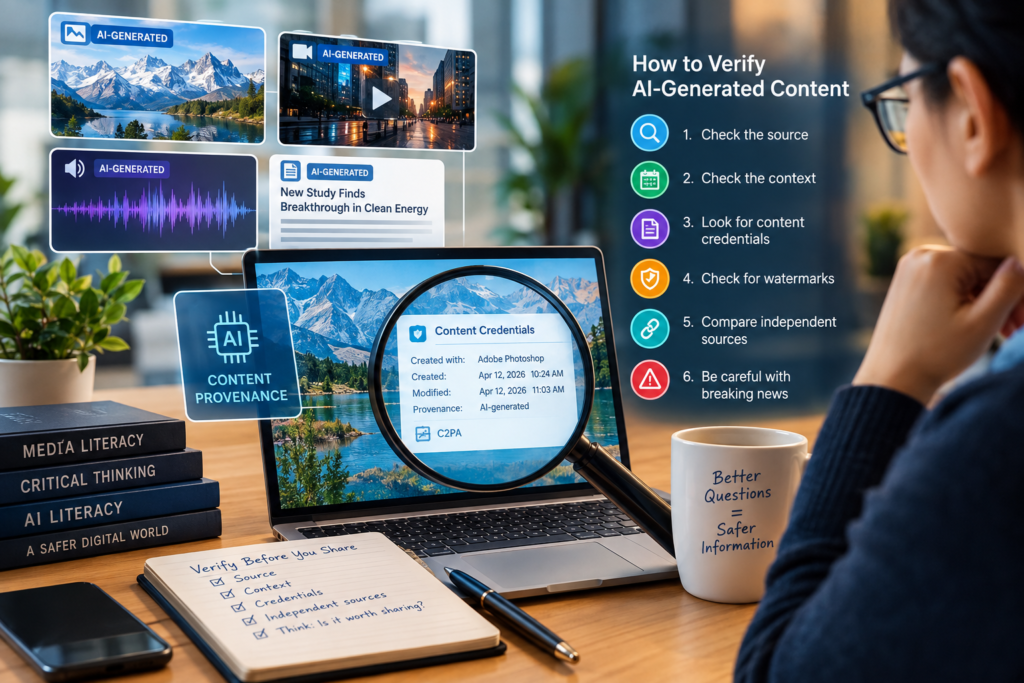
1. Check the Original Source
Before sharing a dramatic image or claim, ask:
Where did this come from?
Look for the earliest identifiable source rather than relying only on reposts.
A screenshot of a social media post is not necessarily evidence of the original event.
2. Check the Context
Even a genuine photograph can be misleading if it is presented with the wrong date, location or description.
Ask:
- When was it created?
- Where was it created?
- Who originally published it?
- What was happening at that time?
A real image with false context can still produce misinformation.
3. Look for Content Credentials
Where available, check whether the image or media contains C2PA Content Credentials or another provenance signal.
These can provide useful information about the content’s creation and editing history.
OpenAI describes Content Credentials as a way of carrying provenance information with digital media, while Google has expanded C2PA-related transparency features across several products.
4. Check for Watermarks
Some AI-generated media contains invisible or otherwise detectable watermark signals.
Google’s SynthID is designed to embed imperceptible signals into AI-generated media, while OpenAI has incorporated SynthID into supported image generation workflows and expanded its provenance work to supported audio.
But remember that watermarking is only one signal.
5. Compare Independent Sources
If a claim is important, do not depend on one website or one AI chatbot.
Compare information from several credible and independent sources.
For major news events, look for established news organizations, official statements, primary documents or specialist fact-checking organizations.
6. Be Careful With Breaking News
Breaking news is particularly difficult to verify.
Information can change rapidly, early reports can contain errors, and old images can suddenly circulate with new captions.
Full Fact’s 2026 analysis specifically found examples where AI chatbots incorrectly interpreted images and videos connected to current events.
Waiting for reliable information can sometimes be more responsible than sharing immediately.
What This Means for Businesses
Businesses have a particularly strong reason to develop AI verification habits.
Imagine a company receives an apparently genuine image showing a product defect, a customer complaint, a news story about its industry or a document supposedly issued by an authority.
Acting on false information could lead to:
- Financial losses
- Reputation damage
- Incorrect business decisions
- Customer confusion
- Legal complications
- Unnecessary public statements
The solution is not to reject AI.
Instead, businesses should establish simple verification procedures.
For example:
Low-risk content:
AI-generated marketing material can be reviewed by the content team.
Medium-risk information:
Important statistics and claims should be checked against reliable sources.
High-risk information:
Legal, financial, security or reputational claims should receive human verification before action is taken.
AI Literacy Is Becoming a Business Skill
In the past, digital literacy largely meant knowing how to use computers, search engines and online services.
Today, another skill is becoming increasingly important:
AI literacy.
AI literacy means understanding both what AI can do and where it can fail.
A digitally capable person should know how to:
- Ask AI useful questions
- Check important answers
- Recognize uncertainty
- Verify sources
- Understand AI-generated media
- Protect confidential information
- Review AI output before publishing
This is especially important because increasingly realistic AI-generated content can make visual appearance a poor substitute for evidence.
A Simple Verification Checklist
Before sharing AI-generated or suspicious content, ask these six questions:
1. Who created it?
2. Where did it originally appear?
3. Is there evidence of when and where it was created?
4. Does it contain Content Credentials or another provenance signal?
5. Can the claim be confirmed by independent sources?
6. Would I still share it if the content turned out to be false?
If the answer to the last question is no, take a few extra minutes to verify it.
Final Thoughts
AI-generated content is not automatically false, and human-created content is not automatically true.
The real challenge is learning how to evaluate digital information intelligently.
Technologies such as C2PA, Content Credentials and SynthID can provide valuable provenance signals, but they work best as part of a broader verification process.
The most useful habit is simple:
Do not ask only, “Does this look real?”
Ask:
“Where did it come from, what evidence supports it, and can I verify it independently?”
As AI-generated media becomes more common, that habit may become one of the most valuable digital skills for individuals and businesses alike.
References
- OpenAI, Advancing Content Provenance for a Safer, More Transparent AI Ecosystem, May 19, 2026; updated July 31, 2026. OpenAI — Content Provenance
- Google, Making it easier to understand how content was created and edited, May 19, 2026. Google — Content Transparency and Verification
- Full Fact, Full Fact analysis shows AI chatbots spouting misinformation about AI-generated images, wars and royal fall outs, August 28, 2026; updated September 2, 2026. Full Fact — AI Chatbots and Misinformation Analysis